Full Title: Net Public Debt Outstanding /GDP Ratio: G7 Countries [Article No. 1.2.8]
日本語タイトル:公的セクター純金融負債残高の対GDP比率:G7各国 [記事 No. 1.2.8]
Posted on August 12, 2026.
[Figure]
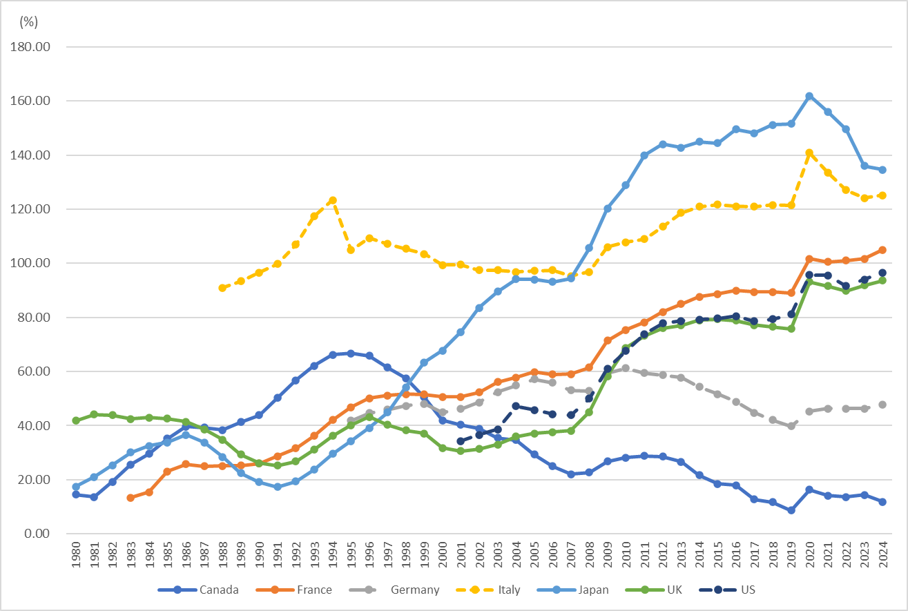
Figure Net Public Debt Outstanding /GDP Ratio: G7 Countries (1980-2024)
Figure 公的セクター純金融負債残高の対GDP比率:G7各国 (1980-2024)
Source: By Yoshida using IMF (2025) “World Economic Outlook, October 2025” data from https://www.imf.org/en/publications/weo/weo-database/2025/april, accessed on Mar. 17, 2026.)
[Facts]
- この図から,公的セクター純金融負債残高の対GDP比率については,G7諸国中,日本が最悪の状況,イタリアが2番目に悪い状況にあることが分かる.
- ただし,項目1で挙げた2国は,両国とも公的セクター金融負債残高の水準自体は継続的に上昇しているにもかかわらず,足元では当該比率が下落傾向にある.
- This chart shows that, among the G7 countries, Japan has the worst ratio of net financial debt outstanding, which its public sector owes, to GDP, while Italy has the second-worst.
- However, although the public-sector financial debt outstanding of each country mentioned in Item 1 has been rising continuously, its ratio to GDP is currently on a downward trend.
[Discussion]
- Facts-Item 2の状況を出現させる主要な原因の一つにインフレーション(物価上昇)が挙げられる.実際に消費者物価指数年平均値の変化率で観て,日本は2022-2024年にかけて,3%前後のインフレを,イタリアは2022年に8.7%強,2023年に6%弱のインフレを経験している.すなわち,「インフレ税」が公的セクター純金融負債残高の対GDP比率の引き下げに貢献しているものと考えられる.換言すると,国民がインフレによる痛みを実感している(これは,インフレがもたらす実質的な増税の結果である)一方,政府は「インフレ税」のおかげで公的セクター純金融負債残高を実質的に償還できることとなる(分子の債務残高値はインフレによって変化しない一方,分母の名目GDPはインフレにより上振れする).
- 次の点には注意する必要がある.当該記事はあくまで,一国経済内の公的セクターの金融負債残高に焦点を当てたものである.一国経済全体での金融資産・負債残高並びに経常収支の状況については [記事 No. 1.2.1-1.2.3]に説明済みであるため,そちらを参照されたい.特に,日本,中国,ドイツは世界で最高レベルの純金融資産国であり,アメリカは世界最大の純金融負債国であること(,更に“グローバル・インバランス”)には注意されたい.
- Inflation (rising prices) is one of the main causes of the situation described in Facts-Item 2. In fact, looking at the annual average rate of change in the Consumer Price Index, Japan experienced inflation of around 3% from 2022 to 2024, while Italy experienced inflation of just over 8.7% in 2022 and just under 6% in 2023. Thus, it can be considered that the “inflation tax” is contributing to the reduction in the ratio of the public sector’s net financial debt outstanding to GDP. In other words, while the public is feeling the pain of inflation (which is the result of the de facto tax increase caused by inflation), the government is effectively able to repay its net public-sector financial debt thanks to the “inflation tax” (since the debt balance in the numerator remains unchanged by inflation, while the nominal GDP in the denominator rises due to inflation).
- Please note the following points. This article focuses solely on the outstanding financial liabilities of the public sector within a national economy. For information on the outstanding financial assets and liabilities of the entire national economy, as well as the current account balance, please refer to [Articles No. 1.2.1–1.2.3], where these topics have already been explained. In particular, please keep in mind that Japan, China, and Germany are the world’s highest-level net financial asset countries, while the United States is the world’s largest net financial liability country (moreover, please pay attention to “Global Imbalances”).
コメント