Full Title: Changes of Current Account Balance of OECD Countries and Others [Article No. 1.2.2]
日本語タイトル:OECD加盟国およびその他の国の経常収支の推移 [記事 No. 1.2.2]
Posted on April 12, 2026.
[Tables]
Table 1 Changes of Current Account Balance of OECD Countries and Others
Table 1 OECD加盟国およびその他の国の経常収支の推移
(Unit: Current account balance ratio to GDP, % )
(単位:対GDP経常収支比率,%)
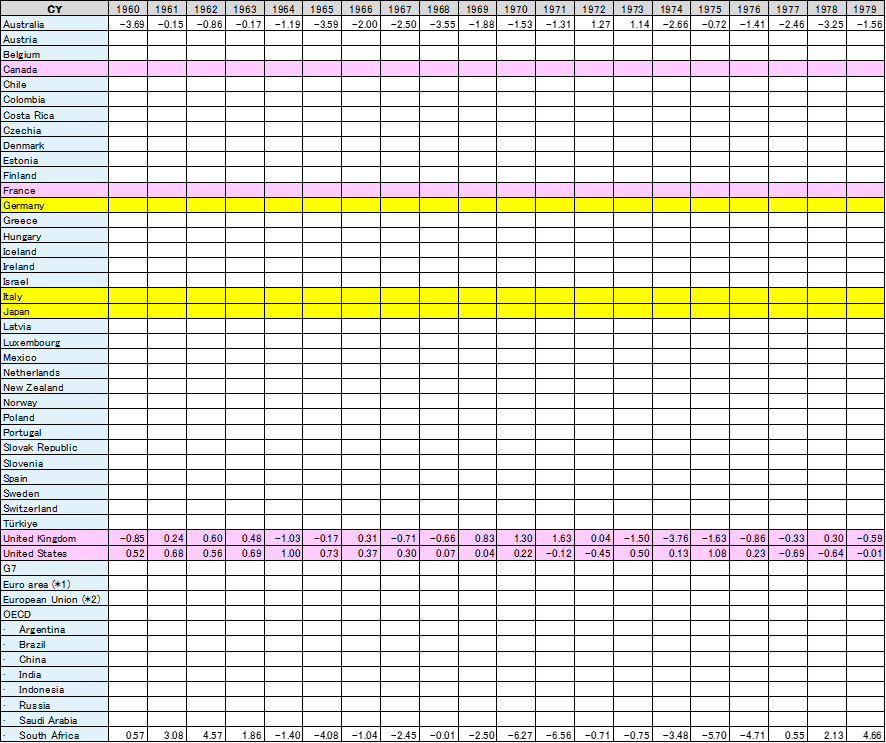
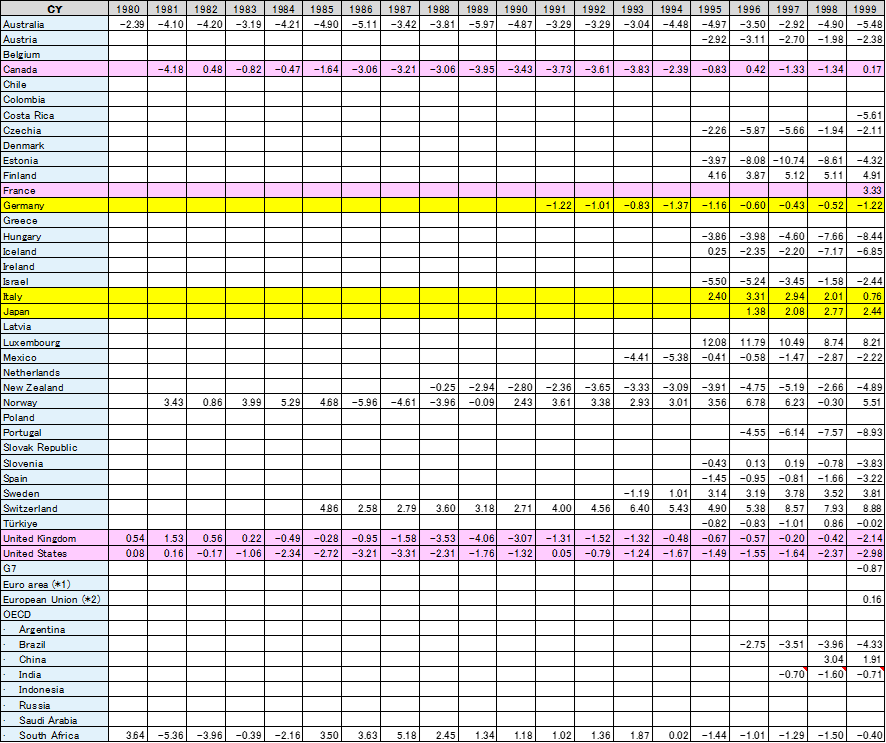
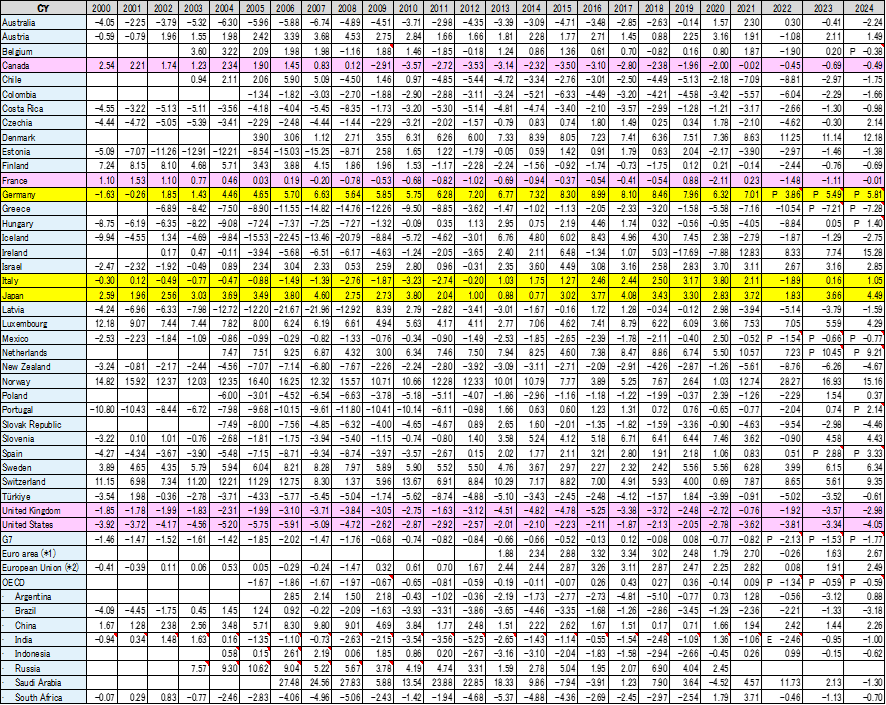
Notes: 1) *1: 20 countries, 2) *2: 27 countries, 3) China indicates People’s Republic of China, 4) E: estimated value, 5) P: provision value. 6) The rows of G7 countries are highlighted.
(注)3) China = 中華人民共和国, 4) E = 推計値,5) P=暫定値,6) G7諸国の行は色付けされている.
Additional note: If a country’s figure is positive (negative) in the table above, the amount of value added gained by the country’s economy is larger (less) than the amount spent by the country’s citizens on consumption and investment, i.e., the country is recognized as a country with surplus (deficit) regarding income. To put this simply, countries with a current account surplus are those that lend their surplus value added (income) to other countries, while countries with a current account deficit are those that borrow the value added (income) they lack to cover their domestic expenditures.
補足説明:上の表において、ある国の数値がプラス(マイナス)である場合、その国の経済が生み出した付加価値の額は、その国の国民が消費や投資した(支出した)額よりも大きい(小さい)ことを意味し、すなわち、その国は所得の面で黒字(赤字)の国であるとみなされる。簡潔に表現すると,経常収支黒字国は他国に付加価値(所得)の余剰を貸し出している国,経常収支赤字国は国内支出を満たすために足りない付加価値(所得)を他国から借りている国ということができる.
Source: By Yoshida using “OECD data explorer” data (URL: https://data-explorer.oecd.org/, accessed on Mar. 15, 2026).
[Facts]
(注意)以下の内容は著者(私)がアクセス可能なOECD(Organisation for Economic Co-operation and Development: 経済協力開発機構)データから確認できた事実である.
- アメリカは1980年代前半以降経常収支赤字を続けている.
- イギリスは1980年代半ば以降経常収支赤字を続けている.
- カナダは2000年代末以降経常収支赤字を続けている.
- フランスは2000年代末以降経常収支の赤字基調を続けている.
- イタリアは2010年代初めまで経常収支赤字基調であったが,それ以降黒字基調に転換している.
- ドイツは2000年代初めより経常収支黒字を続けている.
- 日本は一貫して経常収支黒字を続けている.
- 上記ポイント1‐7をまとめると,G7諸国の中で,2000年代初めより,経常収支黒字を続けているのは日本とドイツのみである.
- 中国は1990年代末以降,一貫して経常収支黒字を続けている.
Note: The following are the facts that I, the author, was able to verify using OECD (Organisation for Economic Co-operation and Development) data available to me.
- The United States has been running a current account deficit since the early 1980s.
- The United Kingdom has been running a current account deficit since the mid-1980s.
- Canada has been running a current account deficit since the late 2000s.
- France has generally run a current account deficit since the late 2000s.
- Italy had generally run a current account deficit until the early 2010s, but has since shifted to a surplus.
- Germany has maintained a current account surplus since the early 2000s.
- Japan has consistently maintained a current account surplus.
- To summarize points 1 through 7 above, among the G7 countries, Japan and Germany are the only ones that have maintained a current account surplus since the early 2000s.
- China has consistently maintained a current account surplus since the late 1990s.
[Discussion]
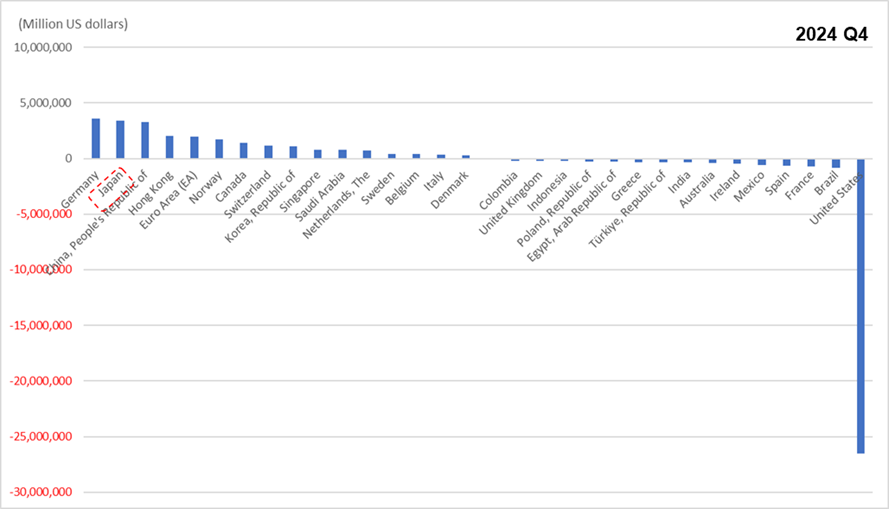
1.世界経済においてはグローバル・インバランス(Global imbalances)と呼ばれる世界的な規模で の持続的な経常収支不均衡が現在問題視されている.グローバル・インバランスは,具体的には,アメリカの経常収支赤字が大規模となり,一方それをファイナンスする東アジア(中国,日本を含む),中東などの原油産出国,ドイツ等の経常収支黒字が大規模となり,かつその状況が持続していることを指す.
2.当該記事の表からも上記ポイント1で示したグローバル・インバランス状況が伺える.
3.なお,このグローバル・インバランス状況を長期に亘り持続可能とした主因はアメリカ・ドルが世界経済における基軸通貨であることに求められる.
4.[Article No. 1.2.3] では,世界各国の純金融資産・負債のストック状況を解説する.しかしながら,世界各国の純金融資産・負債のストック状況を生み出す根本はこの記事で説明した経常収支,すなわち,フロー概念である純所得(獲得した付加価値から支出を控除したもの)の状況である.
- In the global economy, persistent current account imbalances on a global scale—known as “global imbalances”—are currently a cause for concern. Specifically, global imbalances refer to the situation in which the United States runs a large current account deficit, while East Asia (including China and Japan), oil-producing countries in the Middle East, and countries such as Germany run large current account surpluses to finance that deficit, and this situation persists.
- The table in this article also reflects the global imbalances mentioned in Point 1 above.
- It should be noted that the primary reason these global imbalances have been sustainable over the long term is that the U.S. dollar serves as the key currency in the global economy.
- [Article No. 1.2.3] provides an overview of the balances of net financial assets and liabilities in countries around the world. However, the fundamental factor influencing these balances is the state of the current account, i.e., the state of net income (value added minus expenditures: a flow concept), which will be discussed in this article.
コメント