Full Title: Problem on Domestic Investment in Japan (1991-2024) [Article No. 3.7]
日本語タイトル:日本の国内投資問題 (1991-2024) [記事 No. 3.7]
Posted on June 9, 2026.
[Figure]
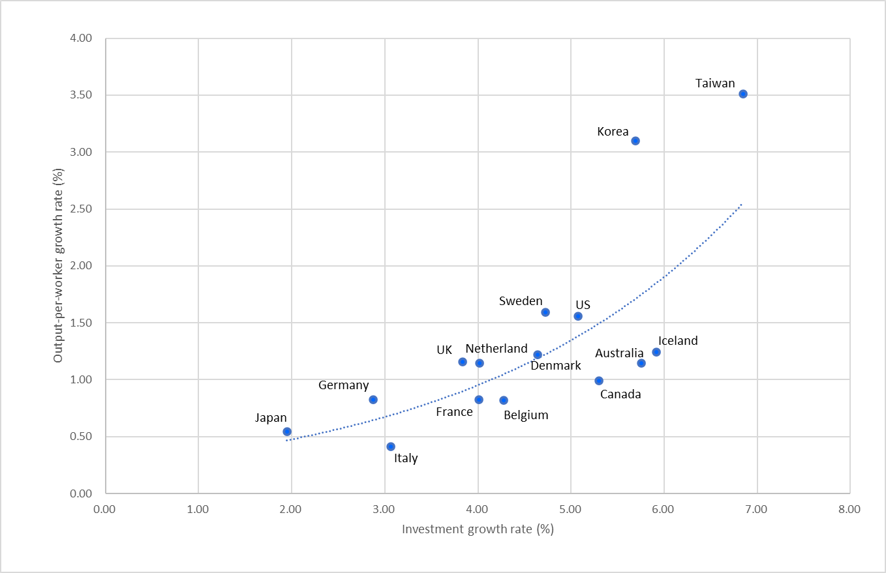
Figure 1 Correlation between Output-per-worker growth rate and Investment growth rate among major countries (1991-2024)
Figure 1 主要国における労働者一人当たりGDP成長率と投資成長率間の相関 (1991-2024)
Note: growth rate = 1991-2024 geometric mean.
(注)growth rate (成長率)= 1991-2024 geometric mean(幾何平均).
Source: By Yoshida using IMF (2025), “World Economic Outlook, October 2025” data,
URL: https://www.imf.org/en/data. (Accessed on Mar. 18, 2026.)
[Facts]
- Figure 1は,G7各国,北欧諸国,韓国及び台湾を対象として,労働者一人当たりGDP成長率と投資成長率間の相関を示している.この図からは,これら二つの指標の間に強い正の相関がある蓋然性が高いと言える.
- この図からは,日本は,イタリアを除く観察対象国の中で,労働者一人当たりGDP成長率と投資成長率共に最低の状況にあることが分かる.
- 近年,一人当たりGDPで日本を上回っている東アジア地域の国々である韓国と台湾は労働者一人当たりGDP成長率と投資成長率共に非常に高い状況にあることが分かる.(参照:記事No. 1.2.6.)
- Figure 1 shows the correlation between output (GDP)-per-worker growth rate and investment growth rate of the G7 countries, the North European countries, South Korea, and Taiwan. This figure suggests that there is a high probability of a strong positive correlation between these two indexes.
2. This figure shows that, among the countries being observed, Japan has the lowest rates of both GDP growth per worker and investment growth, with the exception of Italy.
3. In recent years, South Korea and Taiwan—countries in East Asia that have surpassed Japan in terms of GDP per capita—have demonstrated remarkably high growth rates in both GDP per worker and investment. (See Article No. 1.2.6.)
[Discussion]
1.[記事 No. 1.2.6] と [記事 No. 3.7] の内容に基づくと,2000年以降の日本の一人当たりGDP水準の世界ランクが連続的に低下していることの主要因は1990年代以降の日本における国内投資の脆弱さにあると推察せざるを得ないであろう.更に,[記事 No. 1.2.3] の内容を合わせて考慮すると,日本経済は,長年,余剰付加価値を国内投資に使わずに海外への投資に回し続けていた状況が伺える.
- Based on the contents of [Article No. 1.2.6] and [Article No. 3.7], one must conclude that the primary reason for the continuous decline in Japan’s global ranking of per capita GDP since 2000 lies in the fragility of domestic investment in Japan since the 1990s. Furthermore, when considering the content of [Article No. 1.2.3] as well, it becomes apparent that the Japanese economy has consistently diverted own surplus value-added away from domestic investment and toward overseas investment for many years.
コメント