Full Title: Provision Problem of Public Goods – Part 3- [Article No. 2.4.3]
日本語タイトル:公共財の供給問題- Part 3- [記事 No. 2.4.3]
Posted on June 16, 2026.
[Image]
(In Japanese)
Notes: (1) For a more detailed discussion of public goods, please consult textbooks on public economics at the intermediate level or higher. (2) Regarding the notations of MSB and MSC, SMB (social marginal benefit) and SMC (social marginal cost) are the more common ones.
(注)1. 公共財の詳細については,中級以上の公共経済学のテキストをご覧ください.2. MSB や MSC の表記に関しては,SMB(社会的限界便益)やSMC(社会的限界費用)の方がより一般的な表記です.
Source: By Yoshida.
[Discussion]
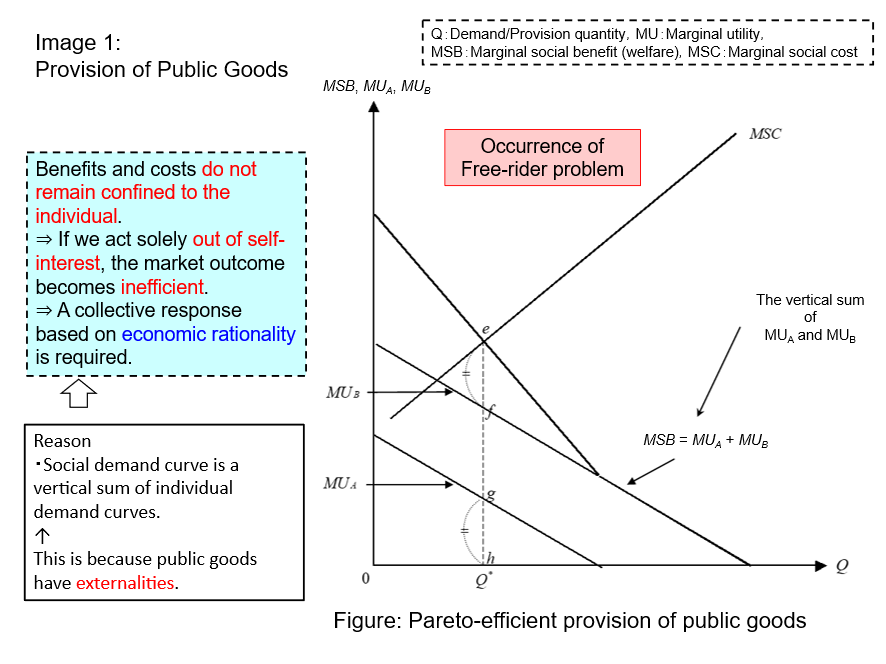
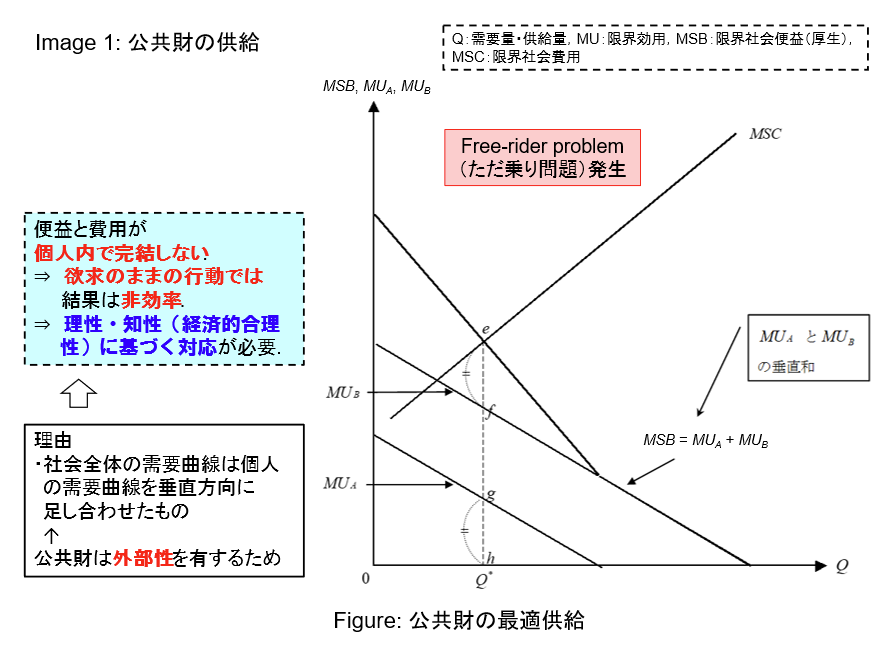
- 公共財のパレート効率的配分は限界社会便益(厚生)曲線と社会的費用曲線が交わる点,均衡点e(供給量 Q*),で決定される.当該均衡点では公共財の効率的配分条件,サミュエルソン条件,が成立している(参照:[記事 No. 2.4.1]).しかし,一般的には,この効率的な公共財供給は実現されない.その理由を以下の2,3,4で示す.
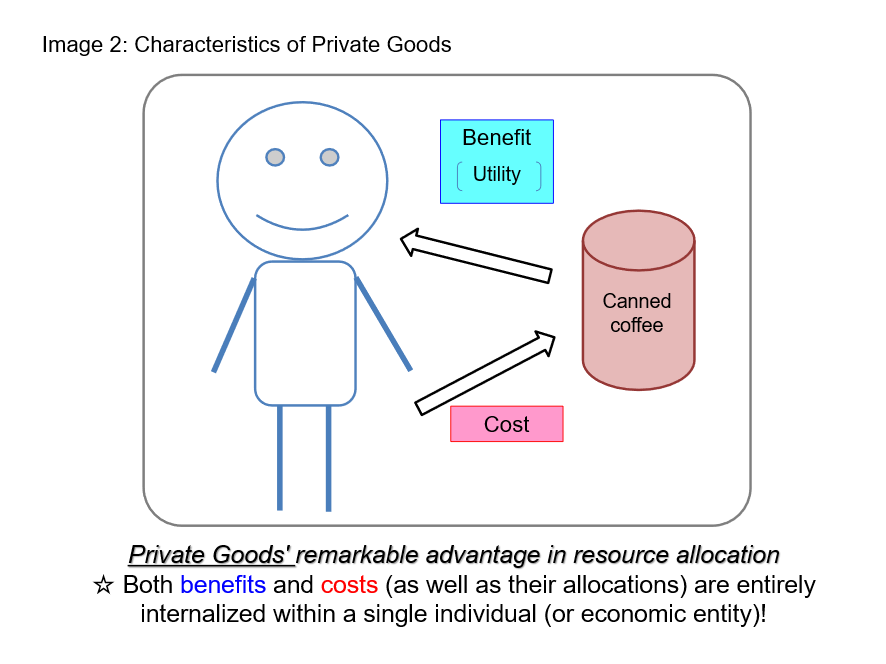
- 公共財に関しては,私的財と異なり,消費者が自らの欲望にのみ従って行動すれば,その効率的な資源配分が達成されるという都合のよい現象は起きない.これは公共財の消費には大きな外部性が発生することに起因する.(参照:[記事No. 2.4.2])
- 公共財は,その消費において外部性を発生させる財,厳密には,消費における非排除性と非競合性*を有している財であるために,その社会全体での需要曲線は各個人の需要曲線の垂直和となる(Image 1).一見,この社会的需要曲線の形成過程は平凡なことのように思えるかもしれない.しかし,公共財の社会的需要曲線がこのように形成されるからこそ(簡単に言えば,誰かが公共財を消費していても,他の誰かもその公共財を同時に消費できるからこそ),公共財消費に関する便益が帰着する各個人にその費用負担をどのように帰着させたらよいかが問題となる.そのため,私的財のように,市場における財価格を介した需給調整を期待することができないのである.
(注)上記説明中,社会的需要曲線=限界社会便益(厚生)曲線,個人の需要曲線=個人の限界効用(便益)曲線である.
(*) これら非排除性と非競合性の特徴を不完全に持つ準公共財も存在する.こうした財の詳細についても,中級以上の公共経済学のテキストをご覧いただきたい.
4. 理論的には,社会の各構成員が公共財から得る限界効用を正直に申告しさえすれば,政府は公共財の効率的供給を保証する費用割り当てを実施することができる,すなわち,各構成員には各人の限界効用の大きさに相当する費用を負担してもらうという費用割当て方法である(この方法による均衡はLindahl 均衡として知られている;Image 1 で言えば,個人Aにghの費用を,個人Bにfhの費用を負担してもらう).しかしながら,公共財が有する非排除性と非競合性の特徴から,各個人は自分の真の限界効用を申告するインセンティブを有しない.寧ろ,各個人は自分の限界効用を過少申告し,適正な費用負担と比べて少なくとも部分的には費用負担を免れたうえで公共財を利用しようというインセンティブを有する.これが公共財のFree-rider 問題(ただ乗り問題)である.
- The Pareto-efficient allocation of public goods is determined at the equilibrium point, e (supply quantity Q*), where the social marginal benefit (or welfare) curve and the social cost curve intersect. At this equilibrium point, the condition for the Pareto-efficient allocation of public goods—namely, the Samuelson condition—is satisfied (see [Article No. 2.4.1]). However, this efficient supply of public goods is not generally realized in practice. The reasons for this are explained in Items 2, 3, and 4 below.
- Unlike private goods, public goods do not yield the convenient outcome where Pareto-efficient resource allocation is achieved simply through private economic agents acting solely out of self-interest. This is because the consumption of public goods generates significant externalities. (See: [Article No. 2.4.2])
- Because public goods possess the twin properties of non-excludability and non-rivalry in consumption, they generate significant externalities, meaning that the social demand curve is derived from the vertical summation of individual demand curves (Image 1). While this formation process may appear trivial at first glance, it is foundational. Precisely because the social demand curve for public goods is formed in this manner, where one individual’s consumption allows another to consume the good simultaneously, the question arises as to how the cost allocation should be determined among the consumers who benefit. Consequently, unlike private goods, we can not expect the market mechanism leads to adjust supply and demand through the price system.
Note: In the explanation above, the social demand curve and the individual demand curve respectively indicate the marginal social benefit (welfare) curve and the individual marginal utility (benefit) curve.
(*) There also exist quasi-public goods that possess these properties of non-excludability and non-rivalry only partially. For details on such goods, please consult textbooks on public economics at the intermediate level or higher.
4. In theory, as long as each member of society honestly reports the marginal benefit they derive from a public good, the government can implement a cost allocation that ensures the Pareto-efficient provision of that public good. Specifically, this is a cost allocation method—known as the Lindahl equilibrium—in which each member bears a cost equivalent to their marginal benefit (as shown in Image 1, Individual A bears a cost of gh, and Individual B bears a cost of fh). However, due to the properties of non-excludability and non-rivalry inherent in public goods, individuals have no incentive to report their true marginal benefit. Rather, individuals have an incentive to underreport it, thereby avoiding at least a portion of the costs they would otherwise bear, while still benefiting from the public good. This is known as the Free-rider problem in public goods.
コメント