Full Title: Premises and Assumptions for the Existence of a Perfectly Competitive Market [Article No. 2.3.2]
日本語タイトル:完全競争市場成立のための前提・仮定 [記事 No. 2.3.2]
Posted on June 15, 2026.
[Image]
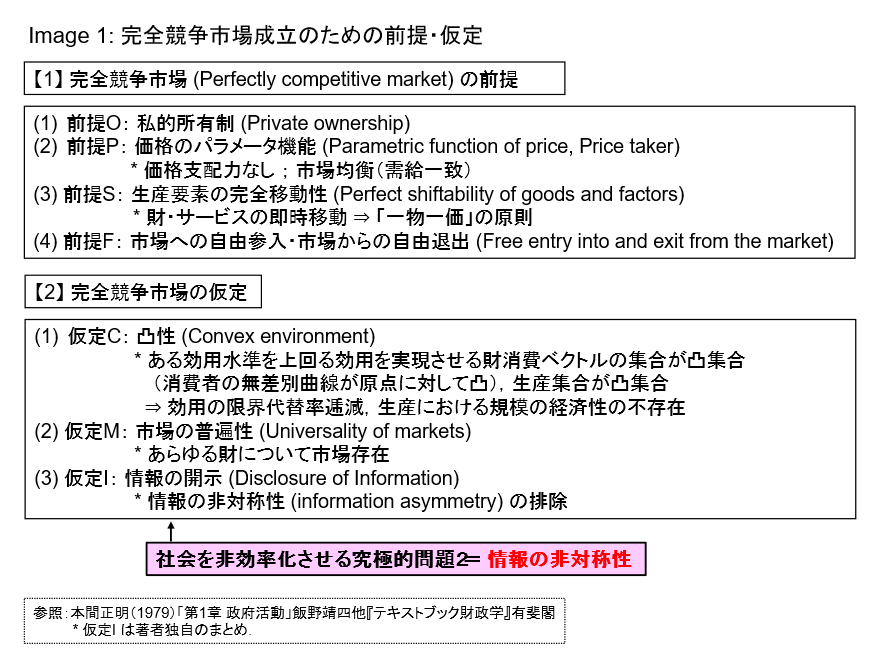
(In Japanese)
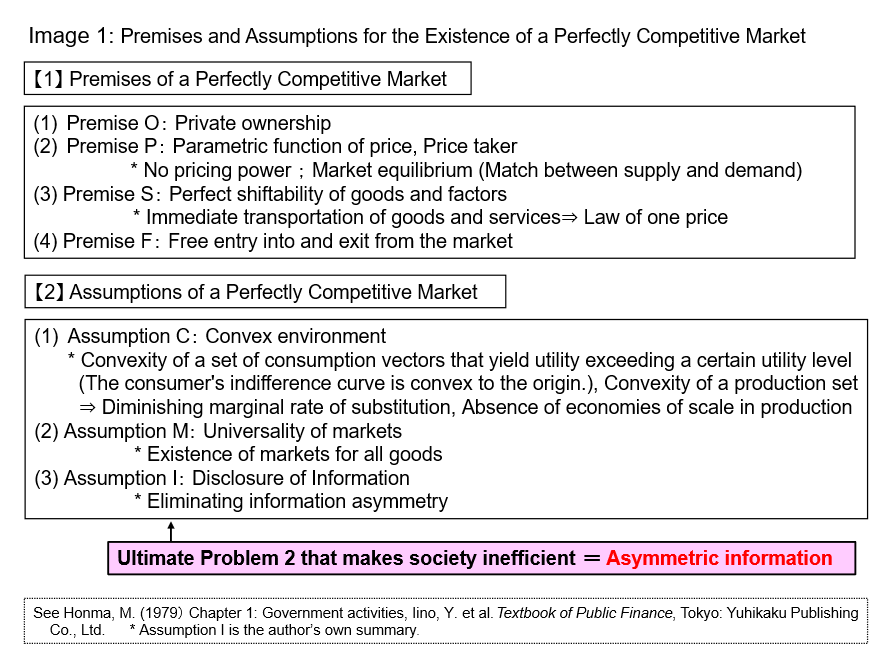
Note: For a more detailed discussion of the above premises and assumptions, please consult textbooks on microeconomics or public economics at the intermediate level or higher.
(注)上記前提,仮定の内容を詳細にお知りになりたい場合は中級以上のミクロ経済学,公共経済学のテキストをご覧ください.
Source: By Yoshida.
[Discussion]
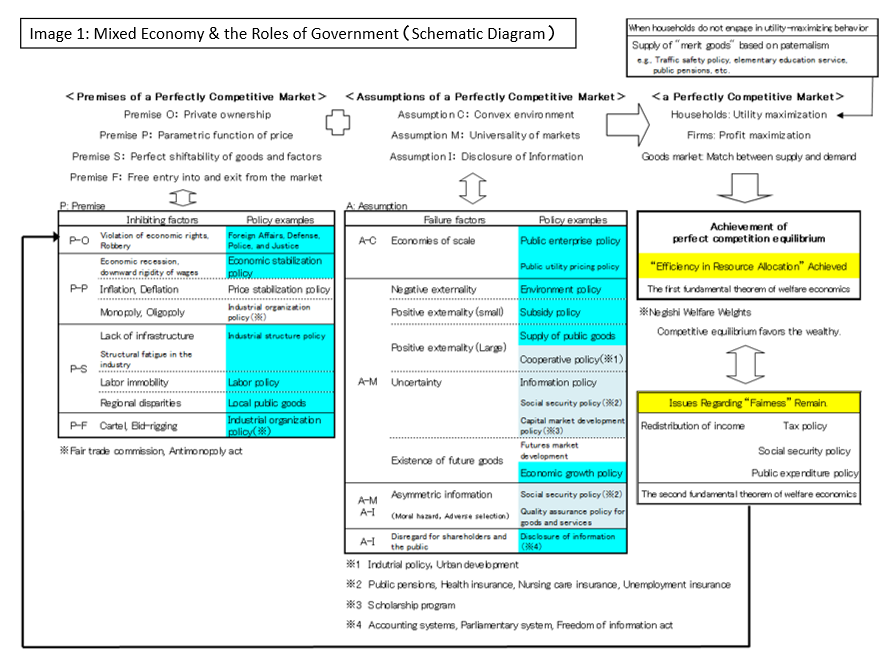
- 私的財の効率的資源配分を実現させるツールである市場が適切に機能するためには,Image 1で示したとおり,様々な前提と仮定が成立している必要がある.しかし,これらの前提や仮定は自然には成立しない.そのため,公的セクター(政府)は「所得再分配」等の仕事を実施する以前にこれらの前提・仮定を成立させるための様々な仕事を実施している.その仕事内容については [記事 No. 2.3.3]で説明する予定である.
- 仮定Iで説明する「情報の非対称性」の存在,実は,この存在こそが社会を非効率化させる二つの究極的な問題*の内のもう一つの問題である(一つ目の問題については,[記事 No. 2.3.1] を参照されたい).情報の非対称性が存在する場合には,情報をより多く有する経済主体は自己の状況を自己にとってより都合の良いものとするために,情報をより少なく有する主体を出し抜くインセンティブを有する.そして,この「出し抜き」が実現すると社会全体の厚生が低下する(この結果については,例えば,贈収賄事件や各種偽装問題等を考えていただければ理解していただき易いであろう).そして,この出し抜きは刑事罰対象の犯罪のみならず,ことの軽重はあるものの,社会のあらゆる場面で発生している.
- For the market, a tool that enables the efficient allocation of private resources, to function properly, various premises and assumptions must hold true, as shown in Image 1. However, these conditions are not automatically guaranteed. Therefore, before undertaking tasks like “income redistribution,” the public sector (the government) carries out various activities to ensure these requirements are met. The details of these activities will be explained in [Article No. 2.3.3].
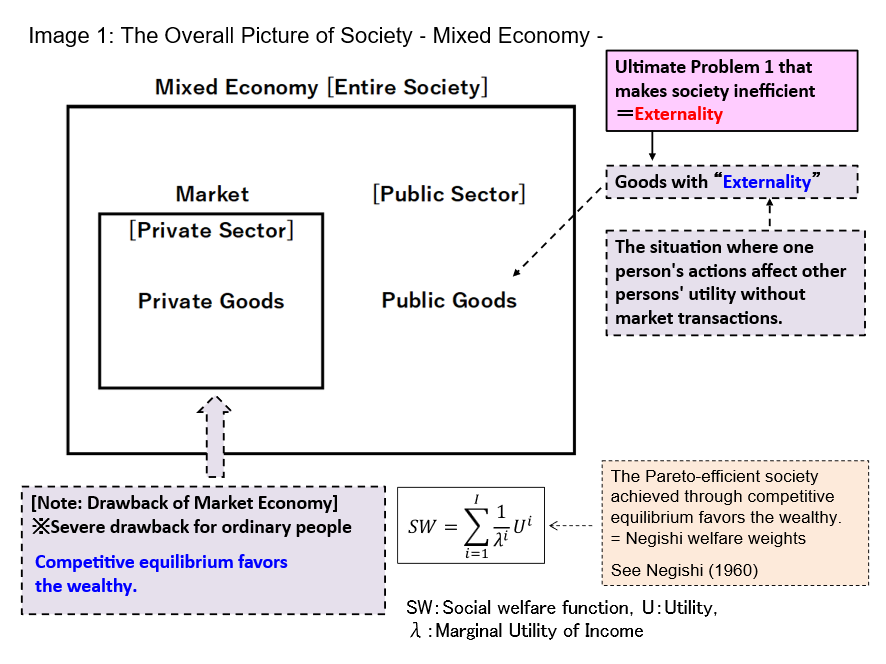
- The existence of “information asymmetry,” as explained in Assumption I, is in fact the second of the two fundamental problems that cause inefficiency in society (for the first problem, please refer to [Article No. 2.3.1]). When information asymmetry exists, economic agents who possess more information have an incentive to take unfair advantage of those with less information in order to improve their own situation. Furthermore, when this unethical behavior occurs, the welfare of society as a whole declines (this outcome is easier to understand when considering, for example, bribery scandals or various fraud cases). Moreover, this behavior occurs not only in crimes subject to criminal penalties but also, to varying degrees, in many aspects of society.
コメント