Full Title: The Overall Picture of Society – Mixed Economy‐ [Article No. 2.3.1]
日本語タイトル:社会の全体像‐混合経済‐ [記事 No. 2.3.1]
Posted on June 15, 2026.
[Image]
(In Japanese)
Source: By Yoshida.
“Reference”
Negishi, T (1960) “Welfare Economics and Existence of an Equilibrium for a Competitive Economy”, Metroeconomica, Vol.12, Fasc.Ⅱ-Ⅲ, pp.92-98.
[Discussion]
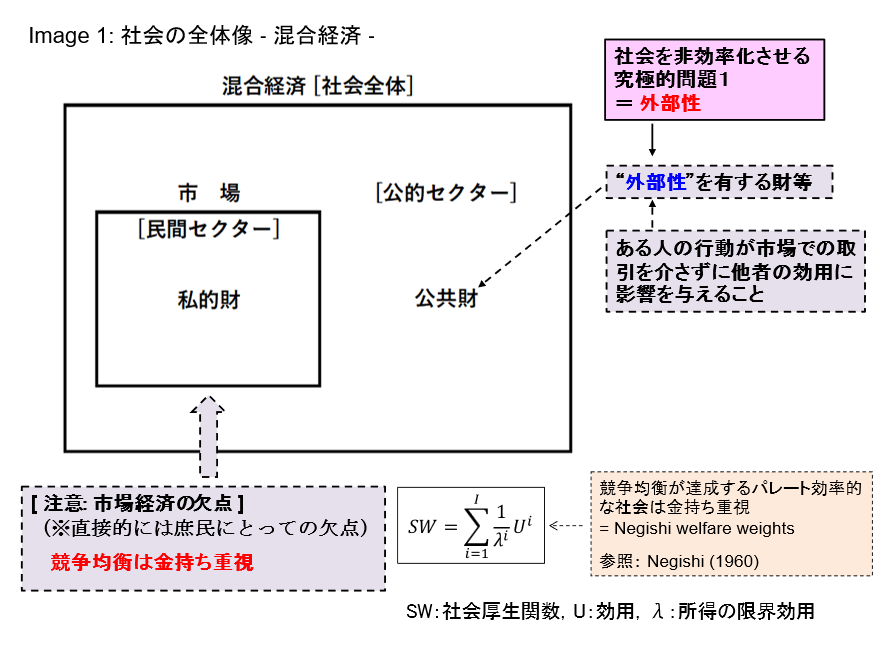
- 現実の社会経済は民間セクターと公的セクターからなる「混合経済」である.社会は民間セクターだけでは成立せず公的セクターが必要である理由については[記事 No. 2.3.2],[記事 No. =2.3.3]で,また,私的財と公共財の違いについては[記事 No. 2.4.1-4]で説明する予定である.
- Negishi(1960)によって,私的財の資源配分を司る市場で達成される均衡(競争均衡)は,社会全体として金持ちを重視した均衡であることが数学的に明らかにされている.具体的には,競争均衡は各個人の所得の限界効用の逆数をウェィトとする各個人の効用の加重和を社会厚生関数とした下での均衡となっている.
(注)豊かな人ほど所得の限界効用は小さいため,その逆数は大きくなる;反対に,貧しい人ほどその逆数は小さくなる(Negishi welfare weights).
3. 公的セクターが担う大きな機能の一つとして公共財の供給がある.この公共財は大きな外部性を有する財(一つの公共財が供給されれば社会のみんながそれを使うことができる財)である.そして,実は,この外部性の存在こそが社会を非効率化させる二つの究極的な問題*の内の一つである.外部性が存在する場合には,社会全体としての効率的な意思決定を実施するためには,社会の構成員はその外部性を考慮に入れた意思決定をなす必要がある.しかし,一般的には,社会の多くの人々は外部性を考慮に入れた意思決定を実施しない可能性が高い.(*) この評価は著者の理解による.
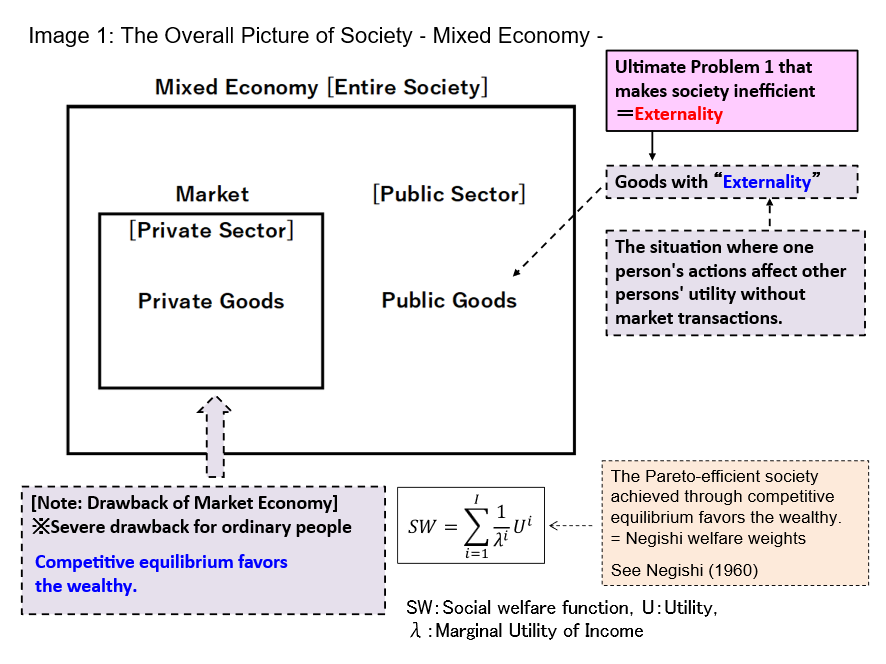
- The economy in real is a “mixed economy” composed of the private and public sectors. I plan to explain why society cannot be sustained by the private sector alone and why the public sector is necessary in [Article No. 2.3.2] and [Article No. 2.3.3], and private goods and public goods in [Article No. 2.4.1-4].
- Negishi (1960) mathematically demonstrated that the competitive equilibrium achieved in a market governing the allocation of private goods is one that prioritizes the wealthy. Specifically, the competitive equilibrium is established under a social welfare function that is the weighted sum of individual utilities, where the weights are the reciprocals of the marginal utilities of income for the individuals.
* Note that because the marginal utility of income is smaller for wealthier individuals, its reciprocal is larger; conversely, the reciprocal is smaller for poorer individuals (Negishi welfare weights).
3. One of the major functions of the public sector is the provision of public goods. These public goods are characterized by significant externalities—that is, goods that, once provided, are accessible to everyone in society. Indeed, the existence of these externalities is one of the two fundamental causes* that make society inefficient (the other cause is discussed in Section 2.3.2). When externalities exist, members of society must make decisions that internalize these externalities to ensure socially efficient outcomes. However, individuals generally lack the incentive to account for external effects, often resulting in decentralized decisions that deviate from the social optimum. (*) This assessment is based on the author’s understanding.
コメント